Thursday, December 2, 2010

Talented young consultants - take the MCA challenge

In recent years our industry has seen a new priority emerge at the Management Consultancies Association – and that is to foster the development and enthusiasm of young consultants who will be the lifeblood of the industry’s future. Top-Consultant.com became sponsors of the Young MCA a year ago as part of a fun drive to broaden the reach of the Top-Consultant brand. Events to date have included a riverboat cruise and talks from networking experts, sporting idols and entrepreneurs. But now the Young MCA have gone a step further and are appealing to consultants’ competitive nature.

Hot on the heels of programmes such as The Apprentice and Dragons’ Den, the MCA have announced the launch of “The 2006 Young MCA Consultants’ Challenge” which will see teams of consultants pitted against one another to complete a series of tasks and challenges. Whilst intended to be a fun event, knowing the consulting industry you can imagine the rivalry there will be between firms to secure their place as leaders of the pack! And for those of you looking to broaden your consulting network, entries are now being sought from teams of young consultants interested in taking part in this month’s event.

The format will see teams of consultants from compete in three activities designed to test the skills management consultants use during their daily work. Top-Consultant are pleased to be sponsoring this charitable event and hope to see as many readers there as possible. For further details and to register a team.

Consultants Reunited

We've been toying with the idea of totally revamping Consultants Reunited to make it a more useable tool for staying in touch with former colleagues and associates - and I wondered if you'd like to provide any input re. the changes you'd like us to make?

When we set the service up we were very conscious of the fact that we didn't want random people to be able to contact you unless they did genuinely know you. Otherwise we felt you'd end up with random headhunters, contractors and the like all contacting you looking for work or wanting to sell their services...

However, we acknowledge we've gone too far in the other direction and although there are thousands and thousands of consulting alumni registered, activity is being restricted because it's hard to find others that you know...

So my question to you is - what changes could we make that would move the service in the right direction, without turning it into a LinkedIn type service where you end up being contacted by people that are not genuine contacts at all?

Anyone with any thoughts, please post them as a comment here. All contributions gratefully received. Rgds, Tony

Management Consultancy recruitment update

Following hot on the heels of last week's Consultancy Careers Fair, I wanted to take a few minutes to record my thoughts on the direction the management consultancy sector is headed, particularly as regards recruitment.

To listen to this 5 minute snapshot, simply turn up the volume on your computer and press the play button below

Financial Services + Public Sector consulting show best prospects for growth

There are some fascinating results emerging from our first Quarterly Barometer of the Consulting Industry (if you haven't taken part yet, click here to do so right away).

The respective health of the US and UK consulting markets are portrayed - as viewed by you our readers. We also look at the consulting sectors that hold the best promise for growth and the preliminary results show consultants are very bullish about prospects for the following sectors:
  • Public Sector
  • Financial Services
  • Healthcare & Pharma
  • Telecoms, Media & Entertainment
Also fascinating are the new technologies and emerging business trends that you feel will present consultancies with considerable new revenue streams in the next years. The full report will be published at the end of the quarter. To be one of the first to receive a free copy of this, simply take part in the short survey today.

Wednesday, December 1, 2010

Are Management Consultants Worth Your Time And Money

To avoid group think or to obtain objective input to the decision process retaining a management consultant may be one of the best choices you can make. A well qualified consultant can lead you to solutions that are unaffected by internal biases and influence. Using experience that comes with multiple years of exposure to diverse companies and industries a consultant will quickly determine the root cause of a problem, assess the impact, guide you to a solution fitting your company and culture, and develop a plan of action that implements the solution with the minimum disruption at the least possible cost.
Completing the action plan could signal the end of the engagement but a consultant worth their salt should have the ability to help you implement the solution, either directly or by recommending other qualified vendors, or by coaching key employees to implement the recommended actions.
Once you decide to hire a consultant how are you going to choose one that best suits your company? Searching the internet will provide thousands of possibilities, but then what? Are all consultants created equal? If not narrowing this list to only include those with serious potential becomes a major undertaking. Searching for and choosing the right consultant should begin in one of the following places: those you've worked with in the past, those recommended by a trusted advisor or those recommended by a trade association representing your industry.
Once you develop a reliable list of three to five prospects subject each to the same interview process you would use to select a key team member. The final selection should be based on the level of trust you can develop with the consultant, their experience and their ability to fit in with your company. Regardless of the length of engagement if you can't trust your consultant, if they don't have the skills and experience you need, or if they rub everyone in the company the wrong way you can't win. You'll spend the remainder of your time on earth telling everyone it isn't worth their time to work with outside consultants. Send your money to me; it will be just as well spent.
So now that you've selected a consultant you can work with what's next? The absolute first thing you must do is to develop a concise, unambiguous statement of work, interim goals, and a schedule. These need to be included as a binding part of the contract and any change to the scope of work must be bilaterally agreed on and incorporated into the contract. Second, use the time between ratification of the contract and the start work date to arrange for facilities and/or network access. Don't put yourself in a position of having to pay for dead air time. Assemble all the materials the consultant will need to begin their task and schedule any previously identified meetings to reduce possible conflicts. Finally, if appropriate, let the employees know that there will be an unfamiliar face around the coffee pot.

Consultants - have your say

It's that time of year again... it's the season to be merry...

... or equally it is the month each year when we give you the opportunity to have a right go at that recruitment consultant who's been totally unprofessional and hopeless in helping you get a new consulting job. Or to praise one that's worked miracles for you. And - on a more serious note - to identify the best strategies and recruitment partners for finding a consulting job in 2006.

So if you've done any job-hunting in the last year and want to have your say
click here now. Our annual recruitment channel survey is published in February and this is your chance to both contribute to the findings and receive a free copy in due course. 1,000+ management consultants take part every year, if you've got 2 minutes to take part then head over to:

Consultants in the dock again

So the Public Accounts Committee has found that of the £2bn + of public money being invested in the services of the consulting industry, around £500 million a year is being needlessly spent. If this is really the case, it seems staggering to me that consulting firms feel the full force of the resulting outcry. Surely if government mandarins squander 1/4 of all tax revenues entrusted to them, it is they that should be in the dock. If they'd spent this money jetting public sector workers around the world to watch every Formula 1 race in the calendar, it would be government rather than Formula 1 bosses in the dock.

Yet this is the peculiar way in which the media report on anything to do with the consulting industry. Conveniently overlooking the fact that these public sector contracts are not hugely lucrative (witness the low profit margins of public sector practices) and can be very risky (think back to the NHS NPfIT programme for an example of consulting firms getting burnt on public sector assignments). Instead we are greeted with headlines like the following and the blame is effortlessly shifted away from those who are truly culpable:

Anger as government pays £63 a second to consultants (The Scotsman)
Labour blows £2 billion-a-year on army of Whitehall advisers (Evening Standard)
Now of course there are examples of consulting projects that have failed to deliver - and a whole raft of reasons for such failures. But to suggest that the majority of this spend has yielded no return to the taxpayer is just farcical.
We are, it seems, doomed to a perception with the public that's just marginally above that of an estate agent or used car salesperson...
Tony Restell

Consulting lifestyle issues

Consulting lifestyle issues - has anything changed?
Just recently got back from vacation and one of the most pleasant aspects of my holiday was not worrying whether I'd get disturbed by urgent calls from the office. Partly this is an acknowledgement of the trust I have in our talented team (thanks all) - but it particularly stood out as it's a degree of relaxation totally at contrast with my experiences as a consulting employee. Back then (pre-2000) interruptions to weekends and holidays were a major source of discontent - and indeed even the possibility of being disturbed was enough to take some of the shine off of one's free time.

During the hols I met up with a friend who's now leaving consulting for these very reasons. Whilst on holiday, a call came in asking what time his plane was touching down on his return. The consulting firm in question wanted to figure out if there was a way of having the consultant get home from holiday, pack things and be back out on a transatlantic flight to start work with a new client that same day (a weekend, incidentally). This got me thinking, have consultancies really not moved on at all in this respect?!
So I thought it would be an interesting exercise to test the water with you all. Do you still:

o have a problem in your office that consultants are disturbed whilst on holiday or go away on holiday uneasy at the prospect that they might be called?

o leave the office for the weekend either knowing that you've got to come back in over the weekend or dreading the fact that you're likely to get a call asking you to?
o find a long-hours culture prevails?
I'd be interested in your feedback, because I'm convinced that simple company policies on these issues would make consulting employees sleep a lot easier and would have negligible impact on client delivery if the senior team members knew that they had to adhere to these rules.

So what have your recent experiences been - do you still suffer from these types of problems? Any others you'd like to flag up too? Post your comments below - I'm looking forward to reading them! Thanks, Tony

Monday, September 13, 2010

So you’d like to secure a new consulting job this Autumn

Early in January this year, I made a series of predictions about the consulting industry that would impact those pursuing a career in consultancy this year. One of my strongest assertions was that “Changing jobs is probably your best chance of (securing) a decent pay hike in 2010”. As many readers have discovered for themselves these last months, the major firms have indeed been able to offer only meagre gains in pay – largely as a function of the continued downward pressure that continues to depress consulting daily fee rates. By contrast, consultants being poached by a competitor are finding that firms are willing to up the ante to attract those who can help fill the critical gaps appearing within their businesses.
Given that this assertion has proven to be true – and with the Consultancy Careers Fair now only a couple of weeks away – I thought I would provide updated guidance on the job opportunities out there in the consulting market and the actions that readers like you can take to maximise your chances of making a successful career switch.
Let me firstly comment on the sea change there has been in firms’ approach to hiring, which manifests itself in two key ways that should underpin your whole approach to getting hired this Autumn:
1) The candidate “Fit” being demanded by firms is now 95% rather than the 75% acceptable in boom years. That’s to say, the match between candidate CV and requirements profile must be almost perfect. The implication of this is perhaps counter-intuitive. Rather than applying to more jobs to ensure success, candidates should instead be cutting back on the number of applications made. The time saved should be invested in making utterly compelling applications for the handful of roles where there really is that genuine 95%+ fit between yourself and the employer requirement. These are the only ones worth the investment of your time and your emotional capital.
2) Clients are looking to make hires who will be immediately billable. Firms are very much recruiting for specific roles rather than undertaking generic hiring to achieve the growth of a practice. This is a market where you must sell how billable your skills are, rather than trying to “change career direction” or “reposition” yourself through a career move. As a consequence your efforts should be entirely focused on tracking down openings where you are a very billable prospective candidate, rather than making speculative applications to “the types of firms who employ people like me.” If there isn’t a specific billable opening that a firm is looking to fill, chances are nothing will come of an application in today’s climate – even if historically consultancies would have pounced on an applicant that looked “like a good fit for the firm.”
How to secure job interviews in today’s economic climate
It should be apparent from the above points that one of the secrets to securing a new role in this market is a devotion to tracking down and applying for a (small) selection of consulting roles for which you are genuinely a highly-qualified candidate – and ensuring you have positioned yourself as such.
By way of a checklist when job-hunting, ask yourself the following questions:
1. Are you restricting your applications on job boards to just those couple of roles where there is genuinely a strong fit between your experience profile and that being sought by the employer?
2. Having identified the handful of roles for which you are genuinely an ideal candidate, have you then taken the time to craft a tailored CV for each and every one of those applications? (Cautionary note: each employer is looking for a different balance of skills and experience, so the “one CV fits all” approach inevitably results in your application coming across as far less compelling when it hits the recruiter’s desk).
3. Are you working with some reputable recruitment agencies? It often comes as a surprise to candidates, but across our industry some 50%-60% of hires are still made via recruitment agencies – despite employers’ best efforts to hire direct and avoid the expense of recruitment agency fees. Indeed there is a “hidden market” of open consulting vacancies that you may simply never tap into if you have excluded agencies from your career change strategy.
4. Have you leveraged your personal network? One of the surest ways to make it to the interview rounds is to have had a recommendation from within the firm that you are a candidate the firm really should be interviewing. Networking with your contacts at firms may also uncover openings that have yet to be signed off, meaning you could be interviewed and could secure the role without it ever even going out to the market. Ask yourself – have you truthfully researched in depth which of your contacts could assist with an approach to the various firms you are considering applying to? Again – this comes down to putting your efforts into ensuring the quality rather than the quantity of your applications. (Cautionary note: I have yet to meet a candidate who is doing this with the rigour and thoroughness necessary to uncover all the opportunities in their network – so even if you’re an active networker there’s almost certainly lots of room for improvement).
The above list is not exhaustive, but should be enough to highlight the gulf between the actions of a regular consulting candidate and someone who is focused on uncovering and applying only to roles for which they are ideally suited. Make yourself one of the rarer candidates adopting a targeted approach like this and you’ll be well on your way to securing your next consulting role – and in all likelihood a decent pay hike too.
Tony Restell will be answering your questions live in the Top-Consultant Q&A area at this year’s Consultancy Careers Fair on 24th September. To register for your place do visit the Consultancy Careers Fair website today. Tony’s recent briefing on the state of the consulting hiring market and the practice areas with the greatest hiring demands can be watched on Youtube

Monday, August 2, 2010

Consulting industry facing double whammy

Tough times lie ahead for those in the consulting industry, make no mistake. Based on my soundings of both leading global brands and niche consultancies, employees have had enough – and are choosing to show this by walking out the door. All the while, lop-sided client demand means firms can do little to sweeten the pill. I can see only one outcome from the double whammy currently facing the consulting industry – and that’s stagnation in consultants’ earnings coupled with an industry-wide push for scale.

For consultants employed in our industry, the next years will see you presented with a stark choice. Staying loyal to your employer is likely to result in only meagre gains in salary. For those wanting to achieve a hike in rewards, looking elsewhere and securing a job offer represents the only plausible route.

For those running consulting firms meanwhile, greater scale will be needed if acceptable margins are to be achieved – which would explain the dramatic pushes for growth and the M&A courting activity we’ve seen of late.

Consulting: an industry that can no longer pay its way

So what are the key components of this malaise in the consulting industry? I would highlight the following:

o As an industry, consulting is tough on the employee and continuous career progression / gains in reward are needed to retain talent.

o Employee costs typically represent two-thirds of the cost base of your average consulting firm. Universal pay rises therefore have major implications for the cost base of a consultancy.

o Advances in employee reward across the industry are therefore contingent on profit margins being fattened, or shareholders accepting a reduction in the returns they enjoy. The latter is unlikely for any sustained period, so pay gains become contingent on finding ways of enhancing the profitability of the consulting industry.

Herein lies the rub. Profitability gains through offshoring have been largely exploited. Downward pressure on fee rates remains intense. Public sector consulting demand has collapsed. Even the rebound in private sector work can only partly compensate. So we find ourselves faced with an industry where staff are restless but employers cannot afford to do anything about it. Readers of our consultants’ forum will have seen this play out over the last months in a series of disappointing pay rounds.

The situation for employers is made all the more acute by the resurgence of the financial services / banking sector and the changes to remuneration that have taken place there. The shift to higher basic salaries and lower bonuses means that compensation at every level looks far more attractive in the City. Consultancies are fighting a losing battle to retain their stars in the face of this remuneration gulf.

The upshot of this all is that firms are adopting a two-tiered approach to rewards. For the general consulting population meagre pay awards and slow or “virtual” career progression are the order of the day (and by “virtual” I mean firms offering progression in job title but with the corresponding remuneration gain postponed or phased in so that a period of higher margin can be achieved). By contrast, new hires can be enticed with more favourable pay offers as these are small incremental costs rather than awards that must be applied to the firms’ whole cost base. A similar story is unfolding for those able to secure a counter-offer. Put bluntly, firms can afford to buy off incremental hires and counter offerees; but they cannot afford to buy off the whole workforce.

Of course across a whole industry a surge in staff churn is costly to address. One of the majors this month announced that employee churn had risen from 8% of staff a year ago to 17% today. That’s a lot of additional hiring that needs to be undertaken just for firms to stand still – and correspondingly a very hefty rise in recruiting costs for any business to swallow, which explains why firms have been making as much noise as they possibly can about their intentions to increasingly hire via social media. The latter of course is low cost and so reduces the financial impact of greater staff churn. But as all seasoned recruiters know, attempts at direct hiring only ever get a firm so far and inevitably significant additional hiring costs will be incurred as staff churn worsens.

All of which leaves individual firms with a narrow set of options. Try to carve out a niche or unique approach that allows some premium to be achieved on fee rates: unlikely. Try to tap into new markets: if only a new fad would present itself. Try to gain share and scale the business so that employee remuneration gains can beat those of the overall market: possible, but mostly at the expense of others in the industry.

The major players in consulting are all making a play to gain share and scale their businesses. Look at the lofty growth aspirations that have been published this last year and it’s clear to all that they can’t all be achieved simultaneously. Pick the employer that wins this battle and you’re likely to be at the upper end of the remuneration curve. But for the industry as a whole, only when client demand surges to the extent that fee rates can truly recover will we see sizeable remuneration gains across the industry. Until then you’re in the realms of either “picking the winner” or of changing employer to secure a rise in earnings. I know which option I would have more confidence in.

Monday, October 13, 2008

Where did all the consulting jobs go

"Where did all the consulting jobs go?" -- it's a headline I've had filed away to use whenever the current banking turmoil started to spill over into the consulting sector.
Yet after 2 days spent with 500-odd consulting recruiters, I have to conclude that the consulting sector hasn't yet been that badly impacted. With the exception of a few isolated hiring freezes and practice-specific redundancy programmes, there's been no bloodbath for the consulting industry thusfar. Indeed, within a couple of hours of the doors opening at our Consultancy Careeers Fair, word spread that one of the firms had already made an on-the-spot offer to a candidate visiting their stand. Towards the end of the event, a tour of the exhibitors confirmed each firm had earmarked dozens of candidates who were a perfect fit for roles they were currently looking to fill. So it's hardly all gloom and doom in the consulting market and readers would do well to remember that we've never experienced an absolute recession in consulting - only ever periods of below-average growth!
Clearly no sector is going to escape unscathed from the current economic turmoil - but it seems at least that the consulting industry has learnt its lesson from the dot-com crash and the over-expansion that necessitated mass-redundancies back then has not been allowed to occur this time round. And for now at least, new consulting jobs are still in relatively good supply...

Tuesday, July 8, 2008

The price of dubious advice - £100bn a year

Just seen a piece that appeared in the Observer this weekend, "The price of dubious advice - £100bn a year".

I'm once again incensed by the reporting of our industry as one built on false promises and deception. Take a read of the article and do post your thoughts on the following forum thread which I've created to allow us to discuss and rubbish this. For what it's worth, here's the reply I've sent to Simon at the Observer - though not holding my breath to see them publish it...

-------------------------------------
Simon

Congratulations on an interesting piece in the Observer this weekend. However consultant-bashing articles do tend to miss one key argument when pointing the finger of blame at consulting firms – and you have overlooked it too. The trade body (MCA) figures show that 66% of each consulting firm’s cost base is the cost of its staff. So allowing for some profit margin, it would still cost Britain plc at least 50% of the current spend on consulting services to just kill off the consulting industry and employ these people in the corporate and public sectors instead.


More often than not, cost over-runs and project failures result from senior management bringing in consultants on a flawed brief. The outcomes are not properly defined; key milestones not established (or constantly revised as the brief is allowed to evolve mid-way through a project); internal resources not dedicated to the project such that the consultants’ meters are ticking but the required access to client staff is being denied. All these management failings would be exacerbated considerably if the pain of a significant bill and ongoing public scrutiny were not ever-present to concentrate the mind.

The current NHS IT investments are a case in point. Richard Granger was able to negotiate with consulting firms a series of risk-reward contracts that saw the firms face severe financial penalties if key milestones and objectives were not met. These financial penalties have now been triggered and at least some of the spend on this ambitious project has now been recouped. Are we really to believe that thousands of extra employees hired by the NHS could have achieved a more favourable outcome than that achieved by the consulting firms? That if employed by the NHS these consultants would suddenly have developed project management skills and capabilities that they were lacking from years spent working in the private sector?

No – the project would have had none of the public scrutiny and been able to recoup not a penny of the costs incurred if the consultancy route had been avoided. The consultants just make a convenient scapegoat and the headline figures of monies spent are always portrayed as an expense that would otherwise not have been incurred.

-------------------------------------

Interested to read your thoughts and hope this turns into an interesting forum thread

Tony Restell
Top-Consultant.com

Thursday, May 8, 2008

Market collapse? ... or business as usual?

There seem to be really mixed messages out there at present - lots of firms seem to be thriving and recruiting really aggressively. But then can consulting really be escaping any fall-out from the credit crunch and the barrage of doomsday headlines we've been seeing?

So I thought I'd turn to you our readers for the definitive view. Let me know your thoughts on the following 3 questions and the results of the poll will appear on screen when you hit submit. Hopefully we can get a couple of hundred responses this month and get a really good picture of what the UK consulting market is doing...

Take part in 1 minute survey

P.S. feel free to post replies to this blog post to share anecdotal evidence as well - either than the market is collapsing or that it's very much business as usual at your firm...

Thanks for participating.

Tony Restell, Top-Consultant.com

Wednesday, February 20, 2008

Consulting industry bounces back after talk of recession

This week I was invited to write a piece for the Consulting Special that appeared in the Evening Standard on 19th February. It's my take on the yo-yo fortunes of the consulting industry over the last few months - and the more positive landscape that now lies ahead. Would be interested to hear your thoughts on my take, so do submit your comments below...

Consulting industry bounces back after talk of recession


After several months of uncertainty, consulting firms now expect 2008 to be another vintage growth year for the consulting industry.

The last months could best be described as “nailbiting” for those at the helms of the world’s major consulting firms. The fallout from the global credit crunch had the consulting industry trembling. Week after week of gloomy headlines had produced an environment in which major corporate clients were reluctant to commit to any new initiatives. Did major corporations need to prepare for a slowdown, or embark on new growth initiatives? With the economic climate on a knife edge, CEOs of the world’s biggest businesses were undecided – and to an extent still are.

We’ve witnessed a difficult few months for consulting firms precisely because there’s nothing worse for them than a period of paralysis. In a booming market there are growth strategies and M&A opportunities to advise on. When businesses are cutting back, consultancies will be right there to help clients decide where to wield the axe. In either market there is business to be won. It’s the grey area in the middle that consultancies fear. With uncertainty about the economic outlook comes a hesitation to sign off new engagements. So after several years of double-digit revenue growth, the leaders of the world’s major consulting brands were staring at a possible consulting recession - if the world’s stock markets didn’t settle and market sentiments show signs of improving.

The problem these consulting leaders face is that their sector is more susceptible than most to periods of economic uncertainty. Within a six month period, the industry can be turned on its head. Firms that were so busy they were turning away business can find work drying up as paralysis prevents new engagements from being signed off. With engagements lasting an average of six months, consultancies face a collapse in their revenues if there are just a few months of economic uncertainty As we entered 2008, this was exactly the situation that consultancies were facing. Lots of new assignments were being discussed with clients, but few deals were actually being closed. The industry was just months away from having to implement cutbacks and redundancies – and with staff costs accounting for 66% of a typical firm’s cost base, redundancy programs tend to be far-reaching once Partners decide they are necessary.

Fortunately a corner has now been turned and the consulting industry is bouncing back. Whilst a few firms are still struggling, most are now reporting that clients are signing off on new projects – and skills shortages rather than a lack of new business look like being Partners’ major headache for the remainder of the year. A combination of interest rate cuts and improved market sentiments have ensured that business leaders cannot sit on growth initiatives indefinitely. Projects are being kicked off again and another bumper year is now being anticipated by consulting Partners. Everyone associated with the sector can breathe a collective sigh of relief.

The impact of all this uncertainty on recruitment has been pronounced. Industry website Top-Consultant.com reports that 22% of consulting employers have delayed the start of their 2008 recruitment drives as a result of the global credit crunch and resulting market uncertainties. January, usually a bumper month for candidates wanting to find a new consulting job, has been somewhat subdued. “Interview cycles have been prolonged by employers and offer letters have taken longer to get out to candidates” confirms Bryan Hickson, a Director at Top-Consultant. “Everyone has been anxious to avoid a situation where new hires were being brought on board just as the market might have been turning. As a result recruitment campaigns were scaled back and those candidates already in the recruitment process found themselves being stalled as much as possible.”

Now all that is changing and the volume of recruitment advertising is finally catching up with the improved market sentiments. A staggering 75% of consulting employers report they are looking to hire staff this year at least as fast as they did in 2007 – and 2007 itself was considered to be an exceptionally buoyant recruitment year. Yet having had recruitment more or less on hold in January, many firms now have some very sizeable hiring targets to hit and only 10 months of the year left to hit them. “We can expect to see a lot of inter-firm poaching of staff and a willingness to bring in talent from outside the consulting industry as the year unfolds” predicts Hickson. Rosier times, it would seem, lie ahead. Unless that is a severe recession bites, in which case a totally different type of cost-cutting consultants can expect to be in demand.

Wednesday, August 15, 2007

Social Networks and Recruitment - What's on MyFace?

Many Top-Consultant readers will already know the name Don Leslie. One of the founder-directors of Management Consultancy recruitment specialists BLT, Don is one of our industry's best-known recruiters. This week's blog entry is the first in a series of guest contributions from Don - who also blogs about Management Consultancy and recruitment on the BLT Blog, http://www.bltog.co.uk/

What’s on MyFace?

As well as using social networking sites such as
Friends Reunited, MySpace and FaceBook to engage and recruit staff (as Ernst & Young are doing), employers are increasingly using these sites to carry out background checks. Although I haven’t heard of any consulting firms doing so, I’m sure they are. According to the Times, a survey of 600 British companies revealed that one in five had logged on to Facebook and other networking websites to vet potential employees. As Steve Bailey from BackgroundChecking.com noted in a recent article:

"We are increasingly asked to undertake media searches and Internet searches as part of our employee screening services and this looks to become a standard element in the future. The findings of these searches can provide valuable insight into personality and current and past events involving a particular candidate who has consented to background checks."


It seems that - finally – members of these social networking sites are realising what damage they might be doing to their career prospects through ‘inappropriate’ postings. Much has been made of the case of the Oxford undergraduate Alex Hill who was disciplined after the university accessed incriminating pictures on Facebook. Hill complained that "I don't know how this happened, especially as my privacy settings were such that only my friends and students in my networks could view my photos." The trouble of course is that it's not just about what you post. It's what others post about you. Here are two close calls I’ve heard about recently…

A friend – let’s call him James – was photographed on a beach. With his trousers down. And a firework between his buttocks. The sequence showed… well, it ended with a burnt bum. You can imagine the rest.

Another, a friend of a friend – let’s call her Alison – was mentioned in connection with some teenage shoplifting adventures.

Both are professionals in their late 30s/early 40s. The incidents were from years back. And – here’s the problem – they were posted on other people’s profiles. Now what would the outcome be if an employer or potential employer were carrying out a bit of due diligence?

Professional networking sites such as
Linkedin.com and Xing.com are all very well. But social networking sites… I’m not so sure. Be careful. There’s more to them than you might think - undertaking due diligence on your own name might be a good start..

All views expressed in this article are those of Don Leslie and do not necessarily reflect the views of Top-Consultant.com

Wednesday, August 8, 2007

Deloitte win 2nd "Consultants Challenge"

The Young MCA this week attracted 12 teams comprising 120 consultants to compete in the 2nd "Consultants Challenge" - a fun inter-firm competition in aid of the charity "Depaul Trust"


Top-Consultant.com sponsored the event for the 2nd year running and £1,600 was raised for charity during the night. This year we brought along ten of our team to "strengthen" any other firms who were short of team members on the night. A big thank you from us to all the firms for welcoming us into their teams with open arms (and my apologies to the KPMG team at this point, to whom my only significant contribution was a series of bull's eyes on the rifle range!).

FINAL RESULTS

With Accenture having won last year's event, this year's was keenly contested and the top six teams at the end of the night were:

1st place -- Deloitte (aka "Glitter")
2nd place -- PwC (aka "Police")
3rd place -- Atos Consulting (aka "Bowler Hats")
4th place -- BT Global Consulting (aka "Blues Brothers")
5th place -- Turner & Townsend (aka "Straw Hats")
6th place -- PA Consulting (aka "Vikings")

* aka names signifying the style of hat the teams had to wear throughout the competition!

A fun night was had by all and our thanks go to Natalia and the rest of the team at the MCA for organising such a great event.

PHOTO GALLERY


Deloitte celebrate winning the trophy, flanked by honorary Top-Consultant team member Sacha Jackson


The KPMG team successfully identify 6 mystery cities, leading me to realise that gap years have moved on a fair bit since my days in the early 90s!
Tony Restell, Top-Consultant.com

Thursday, July 5, 2007

Get your copy: Consulting supplement in today's Times newspaper

We've got a major consulting supplement appearing in today's Times newspaper. Looks like a good read for anyone wanting an update on trends and challenges in our industry.

You can get a free PDF of the supplement by clicking here

Happy reading!

Tony Restell
Top-Consultant.com

Thursday, February 8, 2007

Last week was our annual recruiters' event in London, where we presented the latest recruitment trends to a packed house of management consultancy recruiters. The various findings (bonuses, pay rises, retention rates, candidate acquisition channels, etc.) will be reported in our newsletter over the coming month. But for now - for all those thinking of looking for a new career in consulting - I wanted to share with you just what a buoyant market this now is!

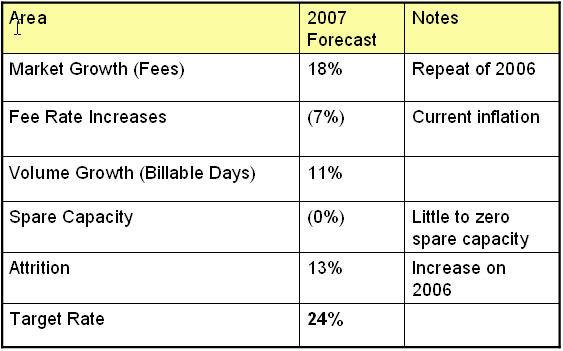
Based on data submitted by all the top consulting firms, we were able to calculate that to achieve revenue growth targets for the year, firms would need to hire the equivalent of 24% of their existing headcount over the coming 12 months. That's a phenomenal level of recruitment activity - and bodes well for anyone who's job-hunting in the next months.


As the chart shows, 18% revenue growth is expected in 2007 - a repeat of the growth seen in 2006. 7% of this revenue growth could come from an inflation of fee rates, but the rest needs to come from billing more days of consulting. With the top firms acknowledging they have no spare capacity at present, the rest of this growth (11%) has to come from bringing in new hires. Add to this the expected 13% staff churn rate for 2007 (up from 10.3% in the last year) and you have the 24% growth rate confirmed.

Exciting times for all you consulting candidates!

;-)

Tony

Wednesday, September 27, 2006

And the brightest consultants are...

Monday night saw the inaugural Young MCA Consultants' Challenge take place in central London, with a dozen teams entered from some of the biggest names in consulting. Comprising teams of ten, the various rounds challenged consultants to demonstrate the skills they use in their everyday lives - communication skills, risk assessment...

Top-Consultant.com were thrilled to be sponsors of the event, with £1,500 being raised on the night to support the DEPAUL TRUST.

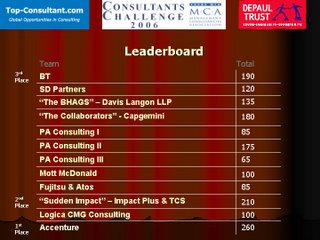
Both Accenture and BT got off to slow starts, with the night looking like it might provide something of an upset. Could one of the smaller firms trounce the bigger names in our industry? Well as the leader board below confirms, Accenture emerged as eventual winners; a joint Tata Consultancy Services / Impact Plus team came second; BT came third.


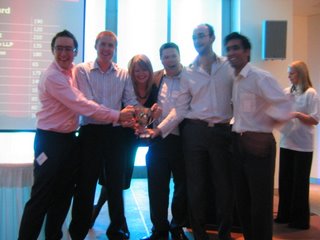
And to give them their moment in the spotlight, here's the winning team from Accenture accepting the winner's trophy:


Thanks to Natalia, Joy, David and the rest of the team at the Management Consultancies Association for organising what was a fun night.

Tony

Tuesday, September 19, 2006

Martin Hancock - charitable donations please!

Many of you will know Martin Hancock, who in 2006 was one of just 7 recruiters named Top Management Consultancy Recruiter in recognition of outstanding candidate feedback from Top-Consultant readers. Well Martin is embarking on what looks like a hellish endurance race together with colleague Tara Benton - and it's all in aid of the charity Sportability.

The Coast to Coast Race will be held over 2 days and will see the two cover a distance of 120 miles through a mix of fell and road running, on and off-road mountain-biking and kayaking.
Tara and Martin hope to raise as much money as possible for this worthwhile cause and you can contribute on a corporate or a personal basis via:
http://www.justgiving.com/prism

Martin & Tara need your help to reach their target of £1,000 - so please help make their effort worthwhile. Rgds, Tony